
Key Highlights
- The chain viper, called russell’s viper, is one of the most dangerous venomous snakes in Asia.
- It is part of the “big four” snakes in India. The other three are the indian cobra, common krait, and saw-scaled viper.
- This snake likes bushy areas, open grassy fields, and places with many plants. It can be found near people since there are a lot of rodents there.
- The snake venom from russell’s viper is very strong. It can give people severe pain, swelling, bleeding, and can even lead to kidney failure that could be deadly.
- You can spot this snake by looking for its thick body and the color pattern. It has dark brown spots set in three rows.
Introduction
Welcome to our guide on the chain viper. This snake species is called Daboia russelii. It is well known and feared in the Indian subcontinent. Many snakebite cases in that area are because of this snake. The chain viper is both beautiful and dangerous. In this article, you will learn about some unique things about it. We will talk about where it lives, how it acts, and why it is so important in nature. Let’s find out more about this snake species found in the Indian subcontinent.
Chain Viper (Echis carinatus sochureki)
The chain viper is a very dangerous snake found in the Viperidae family. Many people mix it up with other snakes, but its right name is Daboia russelii. Out of all venomous snakes in Asia, this one stands out. It is known for its strong bite, so people have to be careful and treat it with respect.
Knowing its type and traits makes it easier to tell this snake apart from other vipers. This snake lives on the ground. It has strong venom. That is why it is one of the most dangerous snakes in this area.
Physical Characteristics
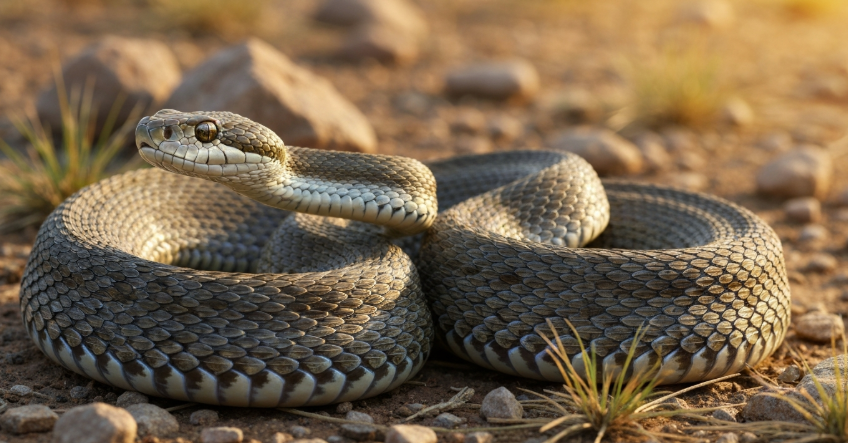
One thing that makes the chain viper easy to spot is its bright colour pattern. The snake’s body is deep yellow, tan, or brown. You will see three lines of dark brown dorsal spots along the length of the body. Each spot is outlined in black. The spots usually have a outer edge that is white or yellow. This chain-like look is why people call it the chain viper.
The head is flat. It has a triangle shape, and you can easily see it is different from the neck. The snout is not sharp; it is round and dull. The eyes are big and have yellow or gold specks in them. The body is thick and strong. The length of the body can grow as long as 5.5 feet. But most of the time, it is about 4 feet long when found in mainland Asia.
This viper has dorsal scales that feel rough because they have strong ridges. Only the row of scales at the bottom is smooth. The size, look, and markings of this snake all come together to make it look different from any other.
Conservation Status
The chain viper is a snake species that is listed as “Least Concern” by the IUCN. This means it is not at risk of disappearing right now. The chain viper lives in many places across the Indian subcontinent. It can often be found in coastal lowlands and plains.
The population of this snake is going down, even though it is still seen as stable. A big reason for this is people building homes and businesses where the snakes live. This takes away the snake’s natural space. In some places, people also hunt and trap them. This adds to the drop in their numbers.
There is some good news now. Recent science work gives us hope. Right now, new antivenoms are going through clinical trials. Tests on some special drugs to fight the venom show good results. This means there could be fewer people dying from these bites in the future.
Highlights of the Study
Recent studies have found new ways to fight the danger of snake venom from the chain viper. The research shows that two main toxins in the venom, called Phospholipase A2 (PLA2) and Snake Venom Metalloproteinase (SVMPs), cause most of the problems in blood clotting. These findings help us understand the lethality of venom and how to deal with it better.
Researchers have found two drugs that can fight against these toxins. This discovery may change the way people treat snakebites.
- Varespladib: This drug blocks the PLA2 enzyme. It helps to stop a main part of the venom.
- Marimastat: This drug stops the SVMP toxins from working.
In late 2016, the Costa Rican Clodomiro Picado Institute created a new antivenom. Clinical trials for this started in Sri Lanka. These steps are very important. They help to cut down on deaths and bad injuries caused by this snake.
Understanding the Chain Viper Snake
To really get to know the chain viper, you need to look at its scientific name. The snake is called Daboia russelii. The genus name, Daboia, comes from a Hindi word that means “the lurker” or “that lies hid.” This fits the snake well, because it likes to stay still and stay out of sight.
This snake is a real viper. But it stands out because of some special traits that make it different from other snakes in its group. In the next section, we will look closer at how the snake is grouped and talk about what makes the chain viper different from other vipers you may see.
Taxonomy and Classification of Chain Viper
The chain viper is also called daboia russelii. It is part of the Viperidae family. George Shaw first talked about it in 1797. He gave it the name coluber russelii. The name is for Patrick Russell, who was a Scottish herpetologist. He studied this snake species in India.
There is a bit of talk about the correct spelling of the species name. Shaw used one “l” in the name. Some people believe it should have two “l”s, like “russellii,” to match Patrick Russell’s name. But the International Code of Zoological Nomenclature usually keeps the original spelling.
Here is a simple breakdown of its scientific classification:
| Classification | Name |
|---|---|
| Kingdom | Animalia |
| Phylum | Chordata |
| Class | Reptilia |
| Order | Squamata |
| Family | Viperidae |
| Genus | Daboia |
| Species | D. russelii |
Key Differences Between Chain Viper and Other Vipers
While the Russell’s viper is a real viper, it has things that set it apart from other vipers. For one, it is not like a pit viper because it does not have the heat-sensing pits between its eye and nostril. But, studies show that it can still pick up heat or temperature, maybe by using nerve endings in its supranasal sac.
Another big difference is in the way it is built. The chain viper is usually slimmer than other vipers, but it is still strong and thick. The snake venom is not the same everywhere. It changes depending on where you find the snake. Because of this, people who get bitten can have different symptoms in different places.
Here are a few key points:
- It does not have the heat-sensing pits that many pit vipers have.
- The eastern subspecies is now called a different kind, daboia siamensis.
- This snake is slimmer than other vipers.
- The venom can change a lot from one group to another.
Origin and Etymology of the Chain Viper
Have you ever thought about how the chain viper got its name? There are two important people and a debate behind it. The name “chain viper” comes from the patterns on the snake. These markings look like a chain. But, the snake’s scientific name has another history.
The genus name Daboia comes from the Hindi word that means “the lurker,” but turned into Latin. The species name was chosen to honor Patrick Russell. He was a naturalist from Scotland. He was the first to describe it. Now, we will look more at what the name means and the debate about the correct spelling of the species.
Meaning Behind the Name
The chain viper gets its name from Patrick Russell (1727–1805). He was a Scottish surgeon and naturalist who worked in India. In 1796, he wrote “An account of Indian serpents, collected on the coast of Coromandel.” In this book, he gave a description of the snake, and he found out it was very venomous by doing tests.
Keywords: patrick russell
When George Shaw gave this snake its name in 1797, he called it Coluber russelii. He did not spell Patrick Russell’s last name right. He used just one “L” in Russell. This small mistake has started a debate among people in science. The name and the way it was written is still talked about now.
According to the rules of the International Code of Zoological Nomenclature, the first way a name is written, even if it is not right, is usually kept. This helps people in zoology keep things stable. Because of this, many experts still use daboia russelii. They do this to keep the old name, even if it has a spelling mistake.
Cultural Significance in India
In India, the chain viper has an important meaning in local cultures. This is mostly because people are afraid of it. The chain viper is known as one of the “Big Four” snakes. These are four kinds of snakes that cause the most serious snakebites and deaths in the Indian subcontinent.
This snake is one of the most known and feared in the area. The snake often lives in places like farms, open fields, or city areas. Because of this, there is more chance for it to meet people. This makes bites more likely to happen. Being so close to people all the time, the snake has become a big part of local stories. People now see it as a very dangerous and venomous animal.
The snake is well known because it is quick to defend itself, makes a loud hissing sound, and has strong venom. A lot of people talk about this snake in stories and daily life because it really is dangerous. Because of the danger it poses, many people in India need to know about snakebites and how to treat them. This is now a big health issue in many places in the country.
Physical Characteristics of the Chain Viper
It is important to know what to look for if you want to spot a chain viper. This snake has some special features. The color of its body can be deep yellow, tan, or brown. These shades help it hide in grass or bushes. You can also see dark spots make a pattern along its body. The length of the body is often big, which makes it stand out a lot. All these things help people know when they are looking at a chain viper.
These special features are important if you live or travel in the places where this snake is found. Let’s look at its markings and other signs close up. This way, you can know how to spot this snake when you are out in the wild.
Distinguishing Features and Markings
The chain viper can be spotted by looking at the pattern of dorsal spots on its body. It has three lines of dark brown spots that go down its deep yellow or brown body. Each spot has a black ring around it, and there is a white or yellow edge on the outside. This makes a pattern that looks like a chain, which is how it got its name.
On top of the head, you can often see two clear dark spots. There is also a pink or brown V or X-shaped mark, and its point faces the nose. The dorsal scales feel rough because they are strongly keeled. But the bottom row of scales is smooth.
Key features to look for include:
- The snake has a flat, triangle-shaped head that stands out from the neck.
- The nostrils are big, and each is in one nasal scale.
- There are three rows of dark spots with rings along the body.
- A clear V or X mark can be seen on the head.
How to Identify a Chain Viper Snake in the Wild
If you see a snake while you are outdoors, it helps to know how to spot a chain viper. This can help keep you safe. A chain viper has a thicker body, a flat head that looks like a triangle, and a special color pattern. Another thing you might notice is the lower edge of the nasal scale. It touches the nasorostral scale. This small detail helps tell the chain viper apart from other snakes.
When the snake feels in danger, the way it acts is easy to notice. It will usually shape its body into several S-loops. The snake then lifts up the front part of its body. After that, it makes a very loud hissing noise. The sound is so loud, people say it is louder than any other snake. If you bother or try to touch it, the snake can strike at you with lightning speed.
Here is a quick guide for identification:
- Pattern: You will see three lines with dark spots that look like a chain.
- Head: It has a flat head that is shaped like a triangle. There is a V or X mark on it.
- Behavior: It will make a loud hissing sound. When it feels threatened, it gets into a shape like an S to protect itself.
- Build: The body is thick and strong. It can grow longer than five feet.
Distribution and Natural Habitat
The chain viper lives in many places across South Asia. You can see this snake in a lot of different areas, but it does have certain places it likes more. It does not like dense forests or places with a lot of water, such as swamps. The chain viper grows well in open fields, bushy areas, plains, and coastal lowlands.
This animal can live in many places because it is very adaptable. It is often found in the hills of suitable habitat. You might see it in spots where people live or work. This is why people often come across it. Let’s look at the places and the types of environment where it likes to live.
Regions Where Chain Viper Snakes Are Found in India
In the Indian subcontinent, the chain viper is found a lot in some places but not much in others. There are many of them in Punjab, on the West Coast and the hills there, and all across southern India, especially in Karnataka. You can also see this snake in the north up to Bengal. It is not seen so often in the Ganges Valley and Assam.
The coromandel coast in India is the first place where people found and named this snake. Their home is not only in India. They are also found in other countries near India.
Here is a summary of where it is found:
| Country/Region | Presence |
|---|---|
| India | It is easy to find in Punjab, and there are many in West and South India. |
| sri lanka | You can see it all over the island. |
| Bangladesh | It is there. |
| Nepal | It is there. |
| Pakistan | It is there. |
Preferred Environments and Adaptations
The chain viper is good at living in different places. But, it likes some places more than others. It does not like very wet or humid environments, such as rainforests and swamps. You will find it most often in drier areas. These are open plains, scrub jungles, and bushy areas.
One big reason it does well is because it can live close to places where people are. Farmland, villages, and even highly urbanized areas have a lot of rodents. Adult vipers mainly eat these rodents. This brings the snakes close to people, and it can sometimes be risky for both the snakes and us.
Here is what it likes about its habitat and ways it fits in:
- This snake likes open places with grass or bushes.
- It stays away from dense forests and places that are humid.
- You will often find it on farmland and close to places where people live.
- It swims well, but most of the time it lives on land.
Behavior, Diet, and Ecological Role
The chain viper is an interesting snake. Most of the time, it moves slowly, but it can be really fast when it wants. The snake comes out at night. It likes to eat rodents. It also eats small reptiles and land crabs. With this way of hunting, it helps keep the balance in its home.
But, when it gets near people, it can be risky. Snake bites from this viper cause big problems for people. The venom from the bite can make the heart and kidneys stop working right. That is very bad for a person’s health and must be treated right away.
Let’s look at how this viper lives every day, what it eats, and why it is an important part of nature.
Daily Habits and Activity Patterns
The chain viper is usually alone and lives on the ground. It spends most of its time by itself. What it does every day can change with the seasons. Most of the time, it is out at night. But, when cool weather comes, it is active during the day. Adults seem slow and lazy. They might stay in one spot for several days if nothing bothers them.
When they feel they are in danger, the way they act changes a lot. They make their bodies into a strong S-shape. After this, they lift up their head and let out a hiss. This hiss is one of the loudest that any snake can make. They can hit out so hard that their bodies lift up from the ground. Young ones are often more jumpy and move around more than the adult snakes.
Key behavioral traits include:
- The animal is mostly active at night. In cooler months, it is out during the day.
- It lives alone and on the ground.
- When it feels in danger, it makes its body into an S shape and makes a loud hissing sound.
- A gravid female, which means she is pregnant, will have a gestation period that lasts over six months.
What the Chain Viper Snake Eats and Its Prey
The chain viper’s food choices change as it gets older. When they are adults, they hunt rodents. This means they go after mice and rats. You will find them often near homes and farms. That is because there are many rodents in these places.
Juveniles eat more kinds of food. They are usually active when it is twilight. At this time, they look for small reptiles, lizards, and different arthropods, such as scorpions and land crabs. Some young vipers may also eat other snakes like themselves.
This snake is important in the food chain. It helps keep the number of small animals under control by hunting them.
- Adults primarily eat: Rodents like mice and rats.
- Juveniles eat: Lizards, small reptiles, and bugs.
- It mainly eats rodents, so this brings it near people.
- It has the same “Big Four” status as the indian cobra (Naja naja) and the krait (bungarus species).
Importance of Chain Vipers in Their Ecosystem
The chain viper is very important in the environment. It helps control pests, mainly by hunting rodents. These snakes eat a lot of rodents, and that helps keep their numbers down. Without chain vipers, the rodents could destroy crops and spread disease. That is why, even though the chain viper can be dangerous, it is good to have them in places where people grow food.
The chain viper does more than help in nature. Its venom can also be used in medicine. The venom clots blood very well. Because of this, experts made a special test named dilute Russell’s viper venom time, or dRVVT. The dRVVT test lets doctors find some autoimmune problems. It works by showing how fast blood can clot.
The venom has a strong effect on the body. It can hurt red blood cells and change heart rate. Many times, it can also cause kidney failure.
- It helps to control the number of rodents.
- The venom is used in the dRVVT medical test.
- A high venom yield means its bite is very dangerous.
- It helps keep balance in its natural food web.
Conclusion
The Chain Viper is a special kind of snake. It has some looks and actions that make it stand out. This snake is important in the places where it lives. When we understand things like where it comes from and how many there are, it helps us see why nature is so full of life. Learning about the Chain Viper and what it means for nature can help us take care of it and keep its home safe. If you want to know more about these snakes or get advice that fits you, feel free to ask our experts for a free talk!
Frequently Asked Questions
Is the chain viper venomous and how dangerous is its bite?
Yes, the chain viper is one of the most venomous snakes in Asia. When it bites, it can put a large, lethal dose of venom into your body. You may feel severe pain. Swelling and bleeding often happen soon after. Without quick help from a doctor, the bite may cause kidney failure. This snake is very dangerous because of these strong envenomation symptoms.
What should you do if bitten by a chain viper?
If you get bitten by a chain viper, get medical help right away. Do not try any traditional methods. You need to be at a hospital to get antivenom fast. Waiting too long after snake bites can get very serious. It might cause bad problems like renal failure and cardiac failure.
Why is the chain viper listed among India’s ‘Big Four’ snakes?
The chain viper is a well-known snake species in the Indian subcontinent. It is one of the “Big Four” venomous animals. Along with three other snakes, it causes most snake bite deaths in this region. Its venom is strong. The chain viper lives in many places and often comes close to people. That is why it has a fearful reputation.
Have you had any experience with a Russell’s viper?
I have not met a Russell’s viper (Daboia russelii) myself, but their story is well known. A common symptom after they bite is severe pain that happens right away. This snake has chain-like spots as its colour pattern. It is also closely related to the Eastern Russell’s viper, called Daboia siamensis.




