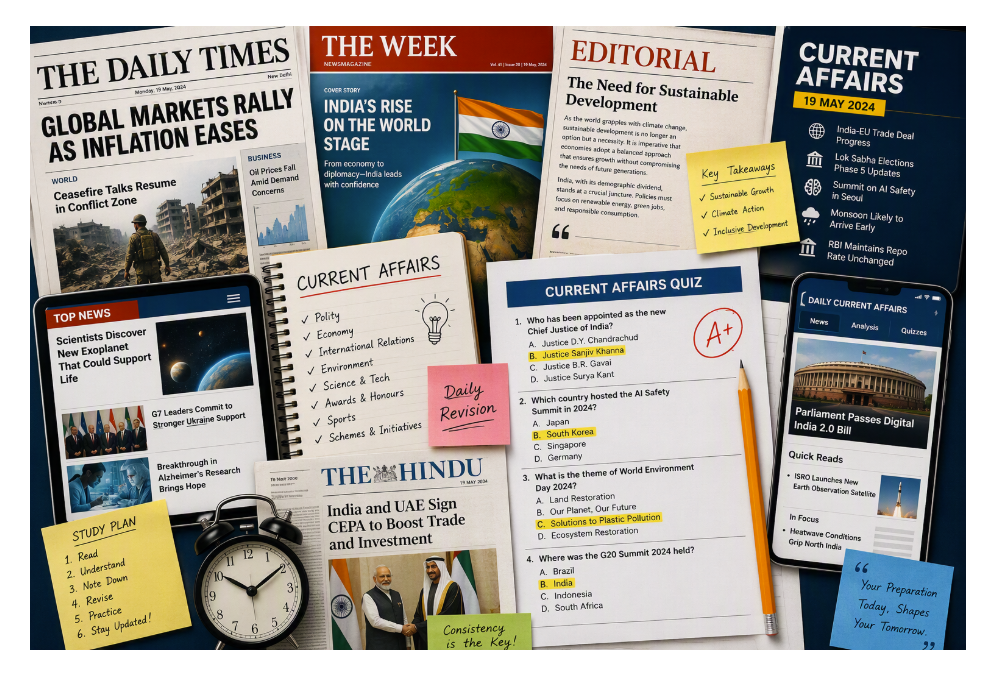
Key Highlights
- Today’s current affairs focus on government decisions, economy, science, sports, and international events useful for UPSC exam preparation.
- Daily news practice becomes easier with a fresh 20-question quiz and a full answer key in plain English.
- A free PDF archive helps you revise month-wise without login or payment barriers.
- Editorial-style learning improves when explanations show why each answer matters.
- Static GK sets support UPSC preparation through History, Polity, Economy, Geography, and Science topics.
- Regular quizzes help you track important updates quickly and revise better.
Table of Contents
Introduction
If you are preparing for UPSC 2026, keeping up with the latest current affairs can feel overwhelming. A simple daily system makes it manageable. Free daily news quizzes, month-wise archives, and clear editorials in explanation form help you stay informed without wasting time. Instead of reading everything, you can focus on major updates, practice questions, and PDF-based revision. That gives you a practical way to build consistency for both Prelims and Mains through regular daily news study.
Current Affairs for UPSC 2026 – Daily News, Editorials, and PDF Summaries
Staying updated with current affairs for UPSC 2026 works best when you follow a fixed daily routine. A fresh 20-question quiz every morning gives you an exam update drawn from national news, government decisions, sports, science breakthroughs, and international events.
What makes this useful is the explanation after each answer. It works like daily editorials in short form, helping you understand the issue instead of only memorizing facts. Add month-wise browsing and a PDF summary for revision, and your preparation becomes easier. The next sections show what to focus on each day.
Essential Topics in Today’s Current Affairs for UPSC
When you ask which news events from today are likely to matter for the UPSC exam, start with the areas that appear repeatedly in daily practice. The platform’s quiz pattern shows a clear exam focus on public policy, governance, economy, environment, science, and major appointments. These are the important topics you should track first.
You do not need to chase every headline. Instead, filter current events by relevance to governance, law, administration, and social impact. That keeps your UPSC preparation sharp and practical.
- Government decisions and legislative changes
- Economy and budget-related developments
- Environment and ecologically sensitive areas
- Science and technology updates
- Appointments and committee recommendations
- Agriculture and scheme-related funding
- International affairs and national events
This mix reflects the kind of important topics that regularly shape UPSC-oriented current events coverage.
Daily News Highlights and Important Editorial Insights
If you want a summary of today’s top current affairs for UPSC preparation, look at how the daily questions are built. The coverage includes national policy, exam reforms, agriculture funding, environmental recommendations, and ministry initiatives. These are the kinds of news highlights that usually deserve more attention.
What adds value is the editorial analysis built into each answer explanation. Instead of a one-line fact, you get a short note in plain English. That helps you connect the event with broader UPSC updates and understand why the issue matters.
| Area | Example of major events and insights |
|---|---|
| Governance | Public Examinations Act amendments and exam system reform task force |
| Environment | Western Ghats ecologically sensitive area discussion |
| Rural administration | DAANVEER initiative linked with digital donations |
| Agriculture | Rashtriya Krishi Vikas Yojana fund-related update |
| Industry | Revised Index of Core Industries with new inclusion |
How to Efficiently Make Notes from Current Affairs for Exam Preparation
A smart note-making method starts after you complete the daily quiz. Read every explanation, even for questions you answered correctly. The short plain-English notes already break down the issue, so your job is to condense them into quick revision points for exam preparation.
Keep your current affairs notes organized by topic, not by random date alone. That makes revision easier when you return to polity, economy, science, or environment later. Month-wise archives also help you fill missing days without confusion.
- Write the topic, event, and why it matters
- Group notes under subjects like Polity or Economy
- Add one-line takeaways from answer explanations
- Mark repeated themes for extra revision
- Use monthly archives to update incomplete notes
These study tips keep note-making focused and useful for UPSC exam preparation.
Accessing Reliable Daily Current Affairs PDFs for UPSC Revision
Finding a reliable PDF for UPSC revision becomes easier when the source is free, updated daily, and organized clearly. The available monthly archive includes current affairs practice papers from 2025 and 2026, which helps you revise old and recent topics without searching across multiple places.
A strong resource access system should save time. Here, you can browse by month, open past sets, and use the June 2026 Current Affairs PDF with 500+ questions across 8 categories. That makes daily current affairs revision more structured.
You also avoid common barriers because there is no login, no paywall, and no app download required. For UPSC revision, that matters. It lets you return to the PDF archive, practice papers, and topic-based sets whenever you need a quick revision session.
Quizzes and Practice Sets Based on Latest Current Affairs
Yes, there are quizzes on today’s current affairs for UPSC practice, and they follow a useful format. A fresh 20-question set goes live every morning. It covers national news, government decisions, sports, science breakthroughs, and international events, which makes daily current affairs practice more exam-oriented.
Beyond daily quizzes, there are also practice sets for static GK. That is important because UPSC preparation needs both current updates and background knowledge. You can use these sets to strengthen areas that support General Studies Paper 1.
- Daily 20-question current affairs quizzes
- Full answer key with short explanations
- Month-wise archive of 302+ practice papers
- Static GK sets on History, Polity, Geography, Economy, and Science
This combination gives you regular quizzes and broader practice sets for consistent preparation.
Conclusion
In summary, staying updated with the latest current affairs is crucial for UPSC aspirants. It not only enhances your knowledge but also helps in strengthening your exam preparation through insightful editorial discussions and comprehensive daily news summaries. Efficient note-taking and access to reliable PDFs can significantly optimize your revision process, making it easier to tackle both the Prelims and Mains. Remember, integrating quizzes and practice sets based on current events will further solidify your understanding and aid retention. Don’t miss out on the opportunity to enhance your preparation—take charge of your study routine today! If you have any questions or need assistance, feel free to reach out!
Frequently Asked Questions
How do daily current affairs benefit UPSC Prelims and Mains preparation?
Daily updates improve UPSC preparation by helping you track issues that matter for both prelims and mains. MCQ practice builds fact recall, while answer explanations improve understanding. This exam strategy helps you connect events with subjects like polity, economy, environment, and governance in a steady way.
Which mobile apps are recommended for daily UPSC current affairs updates?
The compiled information does not name specific mobile apps for UPSC current affairs. It highlights a no-login platform that works directly through daily quizzes, monthly archives, and free study tools. If you want simple daily updates, browser-based access can work well without needing extra downloads.
What’s the best way to revise current affairs for UPSC every day?
The best daily strategy is simple: attempt the 20-question quiz, read every explanation, make short subject-wise notes, and revisit monthly archives for missed days. These revision tips help you manage current affairs without overload and keep your UPSC preparation active every single day.