

Key Highlights
- The full form of PIL is Public Interest Litigation. It is a legal tool in India that helps protect public interest.
- Any Indian citizen or an organization can file a PIL in the Supreme Court or the High Court.
- PILs deal with problems that can affect many people in the community, like environmental protection, human rights, and road safety.
- It came from the idea of judicial activism. This makes justice easy to get for those groups who often do not get help.
- Public Interest Litigations help people use their legal rights and make sure the government does its job. This is done to make social justice better for all.
- The Indian Constitution allows you to use a PIL under Article 32 and Article 226.
Table of Contents
Introduction
Have you ever thought about taking legal action for a cause that matters to your whole community? Public Interest Litigation (PIL) is a strong tool in the Indian legal system that lets people do this. A PIL is a lawsuit that protects the public interest, not just the rights of one person. Through PIL, people can go to court to make sure that the legal rights and fundamental rights of those who cannot go to court on their own are protected. This helps make justice open to everyone.
Understanding the PIL Full Form in Law
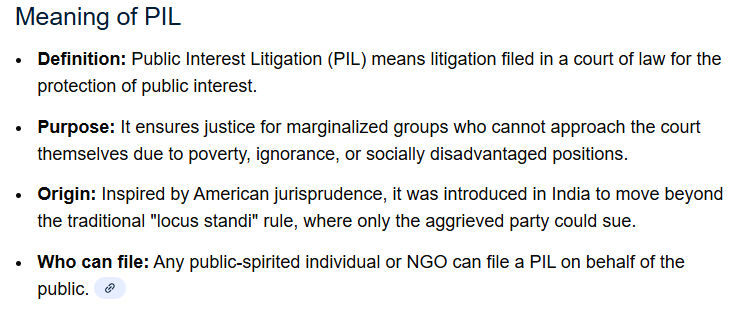
The full form of PIL is Public Interest Litigation. This is an important part of the Indian legal system. A PIL is a type of legal petition that someone can file in court. It’s used when there are matters that impact the public interest or the larger community. A PIL helps people get help from the court when the issue affects many, not just one person.
This law tool lets people share their worries about things like human rights, problems with the environment, and how people live. A PIL can be sent to the supreme court or the high court. It can be used against government groups, including the union of india. This is an important way to make sure the government follows the indian constitution. It helps hold them responsible for what they do, especially with human rights and environmental issues.
Now, let’s look at what this means in the Indian law and see how it started.
What Does PIL Stand for in the Indian Legal System?
In India, PIL means Public Interest Litigation. This is a type of legal action where anyone, by themselves or as a group, can go to court. The goal is to ask the court to help when there is a problem that is in the public interest. It is not for fixing private fights. The court steps in to protect the rights of a community or a section of society. Public interest litigation is there to make sure all people get fair treatment.
Unlike regular lawsuits, in a PIL, someone who cares about the people can go to court for others who are hurt. A person can do this in the Supreme Court by using Article 32 or in a High Court under Article 226 of the Constitution of India. The main idea is to make sure there is justice for problems that affect all of society.
This way, the court system is easier to use, especially for people who may feel left out. Many of these people worry about their constitutional rights and fundamental rights. With this method, it helps them get legal remedies when they face things like pollution, safety risks, or a violation of their rights. The good thing is, justice will not be out of reach just because someone does not have a lot of money.
Historical Context of PIL in India
The idea of public interest litigation in India started in the late 1970s. This came from judicial activism at that time. The concept of public interest litigation became popular because two judges, Justice P.N. Bhagwati and Justice V.R. Krishna Iyer, worked hard for this change. They wanted to open the doors of the courts to people who were poor or facing oppression. Their efforts made justice feel closer and fairer to everyone in the country, especially those who did not feel heard before. The focus was always on the public interest and helping more people with the law.
The first known case of public interest litigation was Hussainara Khatoon vs. State of Bihar in 1979. In this case, the Supreme Court of India looked at the terrible state of prisoners who stayed in jail for many years without even having a trial. The supreme court stepped in and set many people free. More than 40,000 of them were released. The court also said that there must be a right to a speedy trial for all.
Later, in the case of S.P. Gupta vs. Union of India, the court clearly explained what Public Interest Litigation means. This decision made it a part of the Indian Constitution. Now, anyone from the public can go to court if there is an issue that affects the public interest. This also made the power of judicial review stronger in India.
Meaning and Purpose of Public Interest Litigation
Public Interest Litigation is when someone starts a legal action in a court of law to protect the public interest. It does not focus on what happens to one person. Instead, it is about people, a group of people, or the whole society. This type of legal action can help everyone. Public Interest Litigation is a good way to promote social welfare. It gives people a way to speak up for what is right.
A PIL’s main job is to offer legal remedies and make sure there is justice for all. A PIL works for the interest of the public. It makes the government do its work in the right way. Any person can go to court for a public cause through a PIL. This helps the rights of those who are poor or left out be taken care of.
Let’s take some time to see what PIL really means. After that, we can see what social goals it has.
Core Meaning of PIL in Law
The phrase public interest litigation does not have a set meaning in any law or act. Instead, judges have given it meaning and have helped shape what it is over time. Public interest litigation means a legal action started in court by someone to make sure rights that belong to the public or many people are protected. It is a kind of legal action taken for the common good.
A PIL is filed when there is a problem that affects the legal rights or the fundamental rights of a group of people. It is not for one person alone. For example, a PIL can help with things like problems in the environment, workers being used in a wrong way, or children not being cared for. These are issues that touch many people’s lives. A PIL is there so that the law can help a lot of people at the same time.
This kind of legal action is a strong tool for change in society. It lets courts make sure the people in the legislative and executive branches follow the law. This helps them do their job for all the people and keep the rule of law in place.
Objectives and Social Relevance of Filing a PIL
The main aim of starting a public interest litigation is to help everyone get justice. This is important for people who do not have money or other ways to reach the courts by themselves. A public interest litigation tries to support social justice. It works to make sure that the good of the people is put first.
The social value of PILs is very big. They let people stand up for public causes and talk about problems that many face. These are issues that people often miss or look past. When you file a PIL, you can help those whose human rights are not respected. The goals of PILs are:
- The work is to keep and protect the fundamental rights of all people.
- The aim is that the government is open and does what it should in front of people.
- It looks at big problems that affect most of us like environmental protection and public health.
- The goal is to help people who are not strong in the community and make social justice better for them.
A Public Interest Litigation (PIL) is there to help the interest of the public. It gives people a way to talk about big problems that affect everyone. A PIL has helped bring real social and political change in India. This makes it a key part of a working democracy.
Key Features That Define PIL
Public Interest Litigation has some special features that set it apart from other kinds of legal cases. The main point of public interest litigation is that it looks out for the public interest. This means the court of law can look into problems about the legal rights of people in general, not just private arguments between two people. Because of this, the judicial system can better help the people and their needs.
The rules for filing a PIL are not very strict. This helps more people use it for social change. Now, let’s look at who can file a PIL and what makes it different from other kinds of petitions.
Who Can File a PIL in India?
One big change that comes with a PIL is how it relaxes the traditional rule of locus standi. This rule says only the person who has been hurt can bring a case to court. But with a PIL, this idea gets turned around. A PIL lets people go to court, even if they are not the ones directly affected.
Any Indian citizen or an organization can file a PIL. A person does not have to face the problem to file it. The main thing is that the case has to be for the interest of the public. A PIL can be filed by:
- Any indian citizen who acts for a public cause.
- Social action groups or non-governmental organizations (NGOs).
A PIL can be filed only against the State, Central Government, or a municipal authority. You cannot file it against a private person or group. The person who files the PIL must show the court that this issue is about real public interest. It should not be for their own gain or to become famous.
Unique Characteristics of Public Interest Litigation Compared to Other Petitions
A Public Interest Litigation (PIL) is not the same as other legal petitions, such as a standard writ petition. A PIL is a type of writ petition, but what sets it apart is its purpose and the way it works. A standard writ petition is usually started by someone who wants the court to help them when their own rights have been harmed. On the other hand, PILs focus on something larger. They are started to protect the public interest and not just to solve a problem for one person. A person files a PIL to get legal remedies for issues that affect many people or the public as a whole, not just for themselves.
A PIL is different because it is filed to protect the rights of the public or a group that may be left out. A PIL is not for private interest litigation. The court must feel sure that the petition is bona fide, which means it is done in good faith and is for a true public reason. Here are some key differences:
- Focus: A PIL deals with a wrong that happens to the public. A private petition is for a wrong that happens to a person.
- Petitioner: Any person can file a PIL. A private petition needs the person to show that the wrong affects them.
- Motive: A PIL should help public welfare, not the person who is filing it.
- Scope: PILs often cover big topics like human rights, social justice, and caring for the environment.
Because of these things, PILs are a strong tool for change in society. They let judges look at big problems that touch people everywhere. PILs can help work on issues that are part of the whole system. This way, the courts can help all of us, not just one person.
The Process of Filing a PIL in India
If you see a public issue and want to start legal action, you may ask how to file a PIL. The process is set up to be simple. You need to do good research first. You will also need to write a petition to submit to the court of law.
Court fees for a PIL are much lower than in most other legal cases. This makes it easy for many people to file them. A PIL gives people a way to ask for a judicial review if something the government does or does not do hurts the public interest. Let’s go over the steps you need to take and talk about the courts that handle these cases.
Basic Steps Involved in Submitting a PIL
The process to file a Public Interest Litigation is simple. The first step is very important. You have to do good research about the issue. This means you should collect all information, papers, and proof you need to build a strong case about public interest.
When you have the needed proof, you can start to write your petition. In this document, you need to lay out the facts of the case, name the people involved, and list the legal remedies you want the court to give. The basic steps to follow are these:
- Gather all the information and any proof you have.
- Write the PIL petition. In the petition, say what the problem is and ask for what you want.
- Give a copy of your petition to each party you are against (respondents).
- File your petition in the right court. Take two copies if you are going to the high court and five copies for the supreme court.
- Pay the court fees, which are usually just Rs. 50 for each respondent.
After you file, the court checks the petition to be sure that it aims to help the public. The satisfaction of the court is important here. If the court is happy with the reason, your case will move ahead and be heard.
Jurisdiction: Which Courts Handle PIL Cases?
You cannot take a Public Interest Litigation to any court you choose. There are certain courts that can hear these cases about public interest. A person can file a public interest litigation against the state government, central government, or even a municipal authority.
You can file a PIL petition mainly in the Supreme Court or a High Court. The Constitution lets these courts use their power of judicial review in cases about public interest. Sometimes, you can also file it in a Magistrate’s court.
The place where you can file a PIL is clear. You can see it in the table below:
| Court | Constitutional Article / Legal Section |
|---|---|
| Supreme Court | Article 32 of the Constitution of India |
| High Court | Article 226 of the Constitution of India |
| Magistrate’s Court | Section 133 of the Criminal Procedure Code |
Major Examples of PIL in Indian Law
Public Interest Litigation, or PIL, has led to some of the biggest court decisions in India. These important PIL cases changed the country in many ways. They have touched on human rights and on environmental protection. Through public interest, courts have helped make better laws for all of us.
These judgments show how strong PILs are. They can make the authorities answer for what they do and help keep people’s rights safe. The next sections will talk about some of the most well-known pil cases and what came from them.
Landmark PIL Judgments and Their Impact
The history of Indian law has many important PIL cases. These cases have changed the way people live in the country. The judgement of the case in many PIL cases has helped make new rules and saved the rights of many people.
These important cases show how one petition can help make big changes for many people. Here are some well-known examples:
- Hussainara Khatoon v. State of Bihar: This was one of the first Public Interest Litigations. It looked at the situation of undertrial prisoners and made sure they had the right to a quick trial. The case was against the state of Bihar.
- M.C. Mehta v. Union of India: M.C. Mehta filed several Public Interest Litigations against the union of india. These helped deal with big environmental issues. Because of these cases, the court gave orders to clean the Ganga river and to stop industrial pollution.
- Vishaka v. State of Rajasthan: This case led to the Vishaka Guidelines. These guidelines explained what sexual harassment at work was. They also set simple steps to deal with sexual harassment. The case was between several people and the state of rajasthan.
- Asiad Workers Judgment Case: This Public Interest Litigation made sure construction workers got payment of minimum wages. It helped protect labor rights and made the work place better for them.
These decisions show that PILs have played a big role in making sure people get their constitutional rights. They also help to keep social justice strong in many areas.
Real-Life Scenarios Where PIL Was Used Effectively
Public Interest Litigation is not just about big court decisions. People use it to solve many problems that matter to the public. These problems are real and found in daily life. Public interest litigation can help make life better for many. It can bring changes that the people feel and see in their own day-to-day life.
PILs help people reach justice in a clear way. They have been used for many things, like road safety and to help those who need it most. Here are some examples of how people have used them:
- Improving Road Safety: In Parmanand Katara vs. Union of India, a PIL made it a rule for every hospital to give quick medical help to people hurt in road accidents. This move helped save many lives and made roads safer for all.
- Combating Sexual Harassment: A PIL started the Vishaka case to talk about sexual harassment at work. Because of this case, the whole country now follows rules that stop and deal with sexual harassment.
- Protecting the Rights of Undertrial Prisoners: A PIL in the Hussainara Khatoon case helped set thousands of prisoners free. These people were kept in jail for a long time without a trial. Now, their rights as undertrial prisoners are better protected.
These examples show how PILs can help deal with many issues. For example, they can stop the exploitation of casual workers. They also work to keep human rights safe for everyone.
Importance and Significance of PIL Full Form in Law
The role of Public Interest Litigation in the Indian legal system is very important. It helps make sure everyone has the chance to get justice, no matter what their social or money status is. With public interest litigation, people can stand up for public causes and look out for their legal rights. PILs also work to protect the interest of justice and help keep the availability of justice for all.
With help from judicial intervention, PILs now be a strong way to bring social change. They help make sure the government is responsible for its actions. They also let people who are often not heard speak up. Let’s look at how PILs keep public rights safe and what problems people face when they use them.
How PIL Protects Public Rights and Promotes Justice
Public Interest Litigation is an important way to protect public interest. It helps make sure that justice is open to all people. This is very important for those who are from disadvantaged groups. Sometimes, these people do not have enough resources to fight for their fundamental rights. Public Interest Litigation makes it possible for their voices to be heard and their rights to be protected.
Any person who cares about the public or any social action group can file a PIL. This helps bring important problems in front of the court. This way, when people’s rights are not respected, for example, undertrial prisoners or workers who get treated badly, someone can speak up for them. A PIL makes sure that these problems get noticed.
By letting anyone use a PIL, it helps give justice in many ways.
- They help poor and oppressed people reach the judicial system.
- They make sure the fundamental rights are followed for people who can’t go to court themselves.
- They let the court keep an eye on state places like prisons and asylums.
- They give people and groups the power to push for social change.
In the end, PIL is an important tool that helps bring change in society. It makes sure the state does its job and protects the constitutional rights of the people.
Challenges and Critiques Associated with PIL Usage
While PILs have done a lot of good, they also face some problems and criticism. A main issue is the number of frivolous PILs, which are cases started for personal gain, to get publicity, or because of monetary interest. These are different from cases that are truly meant to help the public.
These petitions can use up a lot of the court’s time and can hurt how people see the PIL system. Some main problems are:
- Frivolous PILs: The number of petitions that are not for a real public reason is going up. This puts extra work on the judicial system.
- Judicial Overburden: There are a lot of PILs. This adds more cases to the already long list of cases in the Indian courts.
- Misuse for Private Gain: At times, people use a PIL for their own profit or to fight with others in business. It turns into private interest litigation rather than helping the public.
Courts know about these problems and now take a tougher stand. To stop misuse, judges usually look into the bona fide reasons behind each petition. They do this to make sure it is real. If someone files frivolous PILs, the court can give big fines. This makes sure people use them only for the real reason they were made.
Conclusion
To sum up, knowing the PIL full form and what it means in the Indian legal system is important for anyone who wants to help protect public rights. A Public Interest Litigation gives people a strong way to support justice and deal with social problems that touch most people. Pil lets anyone speak up about their worries. It helps make those in power answer for their actions. This adds to a fairer society for us all. Over time, big court cases and the history of Public Interest Litigation show how these cases have changed to help the public in new ways. As you work or learn about law, keep in mind that learning about public interest litigation can help you take action and be a part of good change. If you have questions or want to know more, feel free to ask for help!
Frequently Asked Questions
What is the full form of PIL in Indian law?
The full form of PIL is Public Interest Litigation. In Indian law, this is a legal petition. People can file it in either the High Court or the Supreme Court under the Indian Constitution. Public Interest Litigation is there to protect the legal rights of the people or a group. It is helpful for those who may not be able to go to court themselves. PIL is important because it stands for public interest and helps more people get justice.
How does PIL benefit common citizens in India?
PIL helps regular people by letting them go to a court of law for problems that affect the interest of the public. It helps bring social justice by giving a way for judges to step in when the government does not act or when there are rights violations. This is a way for people to get legal aid when the whole community faces issues.
Are there any restrictions or limitations when filing a PIL?
Yes, the rule of locus standi is not strict but the PIL must be bona fide and in the public interest. The court will dismiss PILs that are frivolous or just for personal gain. The person who files must show there is a real public cause, and the satisfaction of the court is needed for any legal action to move forward.
What is the full form of PIL?
The full form of PIL is Public Interest Litigation. This is a legal action that people can take in a court, such as the Supreme Court. It is done to protect the public interest and make sure everyone has their legal rights. A person can use public interest litigation to go against government bodies like the Union of India, especially when someone’s legal rights are not being looked after.
P.I.L. क्या है और कैसे दायर की जाती है?
जनहित याचिका (Public Interest Litigation) एक कानूनी तरीका है। इसे कोई भी भारतीय नागरिक जनता के लिए कोर्ट में दायर कर सकता है। आप इसे वकील के साथ या खुद से सुप्रीम कोर्ट या हाई कोर्ट में याचिका के रूप में दे सकते हैं। इसका मकसद यह है कि लोगों की भलाई से जुड़े मुद्दों पर कोर्ट से मदद मिल सके। जनहित से जुड़े मुद्दों पर यह उपाय बहुत जरूरी है।




