
Key Highlights
- The Constitution of India started with eight schedules. Now there are twelve because of several changes made over time.
- These schedules work like appendices. They give extra details to add to the parts of the constitution.
- They talk about many topics. Some are about the territories in Indian states, the division of powers between the central government and states, and the country’s official languages.
- Schedules have a big role in how people run things in India. They show steps on important things like the protection of fundamental rights and local governance in cities through the Twelfth Schedule.
- Major changes in the constitution of india brought in the Ninth, Tenth, Eleventh, and Twelfth schedules. These deal with land reforms, laws about not switching political sides (anti-defection), and local self-government.
Introduction
Have you ever thought about what gives the Indian Constitution its detailed shape? There is more to the Constitution of India than just the main parts. The schedules of the Indian Constitution also play a big role in how things work in India. These schedules are like lists or tables that add extra details to help explain the main points. They make hard ideas easy and help put things in order. In this guide, you will read about all the 12 schedules of the Indian constitution. You will also see why they matter in the way the Government of India runs the country.
Overview of the Schedules in the Indian Constitution
The schedules in the indian constitution are like a backbone for it. They give clear details that the main parts may not show. You can think of them as simple lists. These lists help people know and use the indian constitution better. The schedules talk about many things, like how much pay officials get, and how to look after tribal areas. The main point is that these schedules make it easier for everyone to understand the different constitutional provisions.
It is important to know these schedules to see the whole picture of India’s legal and how the country runs. So, what is in each of the 12 schedules of the indian constitution? Let us look at what they mean, why they are there, and why they are important in the way india and its governance work.
Definition and Purpose of Constitutional Schedules
A constitutional schedule is an appendix in the text. The schedules of the Indian Constitution are like extra pages. These pages have a lot of details that are too much for the main text. They help make the constitutional provisions clear. The schedules keep the main parts simple and easy to read. This idea came from the Government of India Act, 1935. The Indian Constitution used this way to organize things for more clarity.
The main reason for these schedules is to help sort and show complex administrative data. For example, instead of showing all 22 official languages in an article, the names are put in the Eighth Schedule. This makes the legal document easier to read and more clear for people.
Schedules help the government of India and the people follow the rule of law. They give a clear list to look at, so there is no doubt. Schedules make sure the constitutional provisions are used the right way each time. This helps keep things strong and steady in the work of governance in India.
Importance of Schedules in Indian Governance
The schedules are more than just simple lists. They are important tools for governance in India. They help run the country by giving clear rules and groupings. These guide many actions in laws and government. What do the 12 schedules mean for different parts of governance in India? Their effect on india and governance is big and covers many things.
For example, the Seventh Schedule is very important to India’s federal system. It makes the division of powers between the Union and state governments very clear. There are three lists made in it: Union, State, and Concurrent. This helps to stop fights over who is in charge. It also helps the Union and state governments work together in a better way.
They are important for many other parts of governance as well.
- Representation: The Fourth Schedule gives out seats in the Rajya Sabha. This helps make sure that each state and union territory gets fair say in the upper house of Parliament.
- Administration: The Fifth and Sixth Schedules set special plans for running tribal areas. These help protect the rights and needs of people from indigenous groups.
- Judicial and Executive Functions: These schedules also tell us about the oaths that officials, like Supreme Court judges, must take. They show what pay these people get. These rules help both the Lok Sabha and the courts do their work.
Historical Background of the 12 Schedules
The idea of schedules is not something new in the constitution of india. A lot of the framework came from the government of india act, 1935. That law by the government of india had ten schedules in it. When the constitution of india was brought in by the Constituent Assembly in 1949, it started with eight schedules.
As time passed, the nation changed. With these changes, new needs and problems came up. This led to several constitutional amendments. Because of these changes, four more schedules were added. Now, there are twelve schedules in all. Let’s see how they started and which key constitutional amendments shaped them.
Origin and Evolution in the Constitution’s Drafting

The history of the schedules in the Indian Constitution goes back to the time of writing the indian constitution. Dr. B.R. Ambedkar led the Drafting Committee. They saw there was a need to put extra details for the government of india and india in a way that would not make the main text hard to read. So, they used schedules for this work. The people in the Constituent Assembly took ideas from the Government of India Act, 1935. This act also used schedules to add this kind of information.
The Constitution started with eight schedules. These schedules talked about important things. They listed names of states and union territories. They also talked about salaries of top officials, forms of oaths, and how seats are given in the Rajya Sabha. The people who made the Constitution wanted these schedules to be easy to change. This way, they could add more things later on as governance needed it.
This early thinking turned out to be very useful. The move from eight to twelve schedules shows India’s path as it deals with things like land reforms, changes in politics, and giving power to local governments. Because of this, the schedules are now a living and changing part of the Constitution in India.
Key Amendments Affecting Schedules Over Time
Yes, there have been some recent changes to the schedules in the Indian Constitution. A lot of major changes happened many years ago. But, constitutional amendments are still key in shaping the schedules. These changes often show shifts that happen in social, political, and economic life in the country. The indian constitution gets new tweaks through these amendments when needed.
The inclusion of schedules started soon after the Constitution came into force. In 1951, the First Amendment was made. This was an important change, as it added the Ninth Schedule. This schedule was made to protect some laws from being checked by the courts.
Here are some of the constitutional amendments that have made a big impact on the schedules:
- First Amendment Act, 1951: This brought in the ninth schedule. It helped save land reform laws and other acts meant for people’s good. These laws could not be questioned for going against fundamental rights.
- 52nd Amendment Act, 1985: This made the Tenth Schedule. It is better known as the Anti-Defection Law. It was added to stop switching of parties by politicians.
- 73rd and 74th Amendment Acts, 1992: These added the Eleventh and Twelfth schedules. They gave more power to local government bodies in villages (panchayats) and cities (municipalities).
List of 12 Schedules—Summary, Subjects, and Related Articles
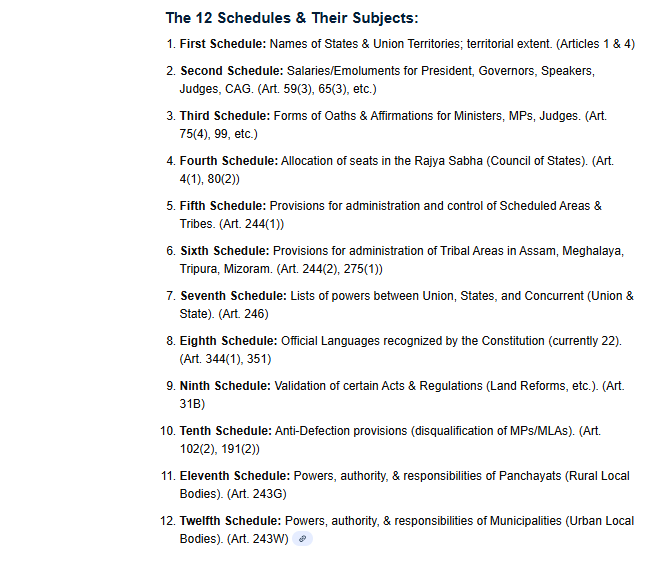
Now that you know the basics, let’s talk about the details of each of the twelve schedules. The list of schedules of the Indian Constitution gives a quick look at what each one covers and the articles they link to. These schedules of the Indian Constitution are very important. They help us see the roles given to the central government and the Indian states.
Can you list all 12 schedules of the Indian Constitution in a tabular format? Absolutely! The sections below give you a good look at how these schedules organize India’s governance. You will find everything from the State List subjects to the different forms of oaths.
| Schedule Number | What’s in it |
|---|---|
| First | Lists the names of the states and union territories. Shows the changes in areas, boundaries, and names. |
| Second | Talks about the pay for top leaders if you want to know. Includes the President, judges, and other public officers. |
| Third | Lays out the forms of oaths or affirmations that must be taken by elected and appointed people. |
| Fourth | Fixes how many seats each state gets in the Rajya Sabha (Upper House of Parliament). |
| Fifth | Deals with management and control of Scheduled Areas and Scheduled Tribes in several states. |
| Sixth | Is about special rules for tribal regions in Assam, Meghalaya, Tripura, and Mizoram. |
| Seventh | Divides the subjects between the Union (Central) List, State List, and Concurrent List for law-making. |
| Eighth | Shows the 22 main languages of India that are used for official purposes. |
| Ninth | Lists laws that can’t be challenged in court if they take away property rights—providing protection when |
Tabular Breakdown of Each Schedule With Its Key Points
The schedules of the Indian Constitution lay out some key details in a clear way. A table is one good way to quickly see what each schedule is for. In this format, you can spot how each schedule, the topics it covers, and the articles in the Indian Constitution are all linked.
This way of organizing helps make the list of schedules of the Indian Constitution clear and useful. People in law, government, and students use it a lot. It works well for all of them. Below, there is a simple summary. It goes over the main points in each schedule.
| Schedule | Subject Matter | Related Articles |
|---|---|---|
| First | Names of States and Union Territories and their territorial jurisdiction. | 1 and 4 |
| Second | Emoluments, allowances, and privileges of high-ranking officials. | 59, 65, 75, 97, 125, 148, 158, 164, 186, 221 |
| Third | Forms of Oaths or Affirmations. | 75, 84, 99, 124, 146, 173, 188, 219 |
| Fourth | Allocation of seats in the Rajya Sabha. | 4 and 80 |
| Fifth | Administration and control of Scheduled Areas and Scheduled Tribes. | 244 |
| Sixth | Administration of tribal areas in Assam, Meghalaya, Tripura, and Mizoram. | 244 and 275 |
| Seventh | Division of powers via Union List, State List, and Concurrent List. | 246 |
| Eighth | List of 22 recognized official languages. | 344 and 351 |
| Ninth | Acts and regulations protected from judicial review. | 31-B |
| Tenth | Provisions for disqualification on the ground of defection. | 102 and 191 |
| Eleventh | Powers, authority, and responsibilities of Panchayats. | 243-G |
| Twelfth | Powers, authority, and responsibilities of Municipalities. | 243-W |
Articles Connected to Each Schedule and Their Relevance
Each schedule is tied to one or more articles in the Constitution. This link makes a clear path from the main law to how it works in practice. The articles are what give the schedule its legal power. For instance, Article 246 lets Parliament and state legislatures create laws about the subjects listed in the Seventh Schedule.
It is important to see how constitutional provisions work together with other parts of the law. The articles show what needs to be done. The schedules explain how to do it and who is involved. This way, the whole legal system is easy to understand and covers all areas.
Here are some examples that show how this works:
- Article 344 and 351: These two parts talk about the Eighth Schedule. This schedule has the list of official languages set by the Constitution.
- Article 102 and 191: These parts work with the Tenth Schedule, also called the Anti-Defection Law. They tell the reasons for which members of Parliament or state legislatures can lose their place.
- Article 243-W: This part helps put the Twelfth Schedule into action. It gives powers to municipalities for the jobs written in it.
The Role of Schedules in Indian Governance and Administration
The schedules are not simple lists. They play an active role in the way governance works in India. They help turn the ideas in the constitution into real policies. The Seventh Schedule is a good example. It shows the division of powers and how this impacts various aspects of governance in the country.
This schedule is a key part of how India is run. It shows which powers go to the central government and which go to state governments. This helps stop mix-ups and makes running things in India smoother. You will read more about how these rules affect government work and why they matter for people who study about India.
Impact on Central and State Functions
The 12 schedules play an important role in how governance works in India. They help shape many things, but they are most important when it comes to division of powers. This can be seen in the Seventh Schedule. The Seventh Schedule lays out which things the central government controls and which things the state governments handle. This makes it easy to see what each side can do. Because of this, India’s system has both central and state features, which is why it is called a “quasi-federal” system. The schedules, especially the Seventh Schedule, give a strong base for how people in India are governed.
The schedule makes three lists: Union, State, and Concurrent. These lists say what things the central government and the state governments can make laws about. This way, the central government takes care of what is important for the whole country. The state governments can have control over their own local things. This helps keep power in balance between the center and the states.
This part helps strengthen the rule of law. It also makes governance better and helps things work well.
- Clarity in Legislation: The Concurrent List helps in giving clarity to both the center and state governments. It makes clear who can make laws on a subject, so there are not many disputes.
- Cooperative Federalism: With the Concurrent List, both the central and state governments get a chance to make laws on big subjects like education and forests. This helps them work together.
Highlights for UPSC Preparation and Academic Study
The schedules in the Indian Constitution are important for UPSC preparation. If you are an aspirant or a student studying political science, you need to know these well. The list of schedules of the Indian Constitution often comes up in the Indian Polity section of the exam. A good understanding of these schedules will help you get better marks in this area. So, make sure to read and remember the schedules of the Indian Constitution as you get ready for UPSC.
Examiners often ask questions that are linked to the subjects in the schedules. They also ask about the constitutional articles and the amendments that brought these changes. So, having clarity on these points is very important. It can help you get the right answer instead of the wrong one in both the preliminary and main exams.
Here’s why they are so important for study:
- Core Concepts: They talk about basic things like federalism, how local government works, and rules for running things in a country.
- Direct Questions: Many questions you see in past UPSC papers are asked straight from the content given in the schedules.
- High-Yield Topic: This is an important topic. You will see it show up often in search results for UPSC study materials. This tells us many aspirants need to read about it.
Distinctions Between Schedules and Articles in the Constitution
It is easy for people to feel mixed up about the different parts of the Constitution. So, what is the difference between schedules, articles, and parts? Even though these parts all connect, each one has its own job. Articles are the key legal rules that make up the main body of the Constitution.
The schedules of the Indian Constitution are like extra lists or notes put at the end, much like appendices. These give more details and extra information to help explain the articles. This way, the main text stays clear and easy to read. The next sections will go into this difference, and you will see examples that show how subjects are split up in the indian constitution.
How Schedules Differ From Constitutional Parts and Articles
Sure. In the Indian Constitution, articles and schedules are not the same. Articles are the main rules. They are the base of all laws and principles for governance. Each article explains one point of law or the way things happen in the country.
Parts are made to put many related articles in the same group. For example, Part III groups all articles about fundamental rights together.
Schedules are at the end of the Constitution. A schedule has extra details or lists of things linked to the articles but not shown right away. So, articles give laws, parts group similar articles, and schedules give support or more information to the articles.
This is how the Indian Constitution puts together its rules about governance and fundamental rights.
Schedules are extra lists that give more details about the articles. They are there because putting all this in the articles would make the Constitution too long and hard to read. The schedules are at the end, but they are still part of the constitutional provisions.
Here’s a simple way to see the difference:
- Articles: These are the legal rules and main ideas in the law (for example, Article 246 says that there will be a split of law-making powers).
- Schedules: These have the detailed lists to go with the articles (for example, the Seventh Schedule gives the list of topics under the Union, State, and Concurrent lists that are in Article 246).
Examples of Subject Distribution Across Schedules and Articles
Let’s make this easier to understand by looking at a few examples of subject distribution. The link between articles and schedules is about giving a basic idea and then adding more details. An article will set up an idea or main rule. A schedule will then give the clear details you need to use that rule.
For example, Article 246 tells us what law-making powers the Parliament and state legislatures have. If you want to see which subjects are under their control, you need to look at the Seventh Schedule. This has the Union List, State List, and Concurrent List. The article does not feel complete without this schedule.
Here are other examples of this synergy:
- Oaths of Office: The Third Schedule lists the forms of oaths that many officials must take. Articles like 75 and 99 say they have to do this.
- Tribal Administration: Article 244 is about how tribal areas are run. The Fifth and Sixth Schedules give more details about how these tribal areas should be looked after.
- Rajya Sabha Seats: Article 80 talks about the rajya sabha and how it is set up. The Fourth Schedule shows how the allocation of seats is done for each state.
Focus on the Twelfth Schedule—Urban Local Governance
The Twelfth Schedule is an important part of the Indian Constitution. It is mainly about making city governments stronger. The purpose of the Twelfth Schedule is to support local governance in cities. This part was added by the 74th Amendment Act in 1992. It helped give full rights and power to local bodies, like municipalities, so they can handle many jobs in the city.
The Twelfth Schedule lists 18 subjects. These subjects come under the control of local bodies. This means these city governments can plan, manage, and decide on many things about urban life. This helps improve local governance and gives more power to people in their own cities.
Before this change, many towns and cities did not have the power or money they needed to deal with the problems growing in urban areas. The Twelfth Schedule, much like the Eleventh Schedule—which lists the responsibilities of panchayats in rural areas—sets out what city governments need to do. The goal is to give more power to local areas and help democracy work better for people. This way, governance in urban areas can be more open to what the people in the city want and need.
Purpose and Coverage of the Twelfth Schedule
The main aim of the Twelfth Schedule is to give more power to urban local bodies. This schedule gives them a clear role under the law. It was made to make local governance stronger and to help cities work well as local government. The Twelfth Schedule shows what local bodies can do and what they are in charge of. This helps municipalities take care of urban development in a better and long-lasting way.
This schedule lists many jobs that are key for city living. It turns towns and cities into more than just offices for the state government. Now, they become active groups that have their own jobs to do. The main idea is to bring governance nearer to people. This helps local people find their own answers to local problems.
The Twelfth Schedule shows that the Constitution sees why having a system for local governance in cities is important. This part of the law helps make rules so towns and cities can get money, plan for growth, and give needed public help to many people living in cities across India. The twelfth schedule is there to support good local governance and improve governance across the country.
Subjects Included in the Twelfth Schedule
The Twelfth Schedule has 18 areas of work that are the job of local bodies in towns and cities. These areas touch everything about city life. They start from things like roads and water and go on to social growth.
This list lets local bodies make rules and run programs in these 18 areas. The twelfth schedule helps them take care of these things in the way they feel is best.
These subjects are important because they help keep life good in urban areas. For example, public health is a key subject. It lets cities take care of things like sanitation, waste removal, and health care services. This is very important, especially when the city has a lot of people living in it.
Some of the main subjects that are in the Twelfth Schedule are:
- Town planning is part of urban planning.
- It also covers rules for how land is used and how buildings are built.
- This includes roads and bridges, public health, keeping things clean, lots of services, and how we handle trash.
- There is help for poor people in cities, and we work to support culture, learning, and the look of the area.
Accessing Official Sources for the Indian Constitution Schedules
When you read a legal text like the Indian Constitution, it is important to use official sources. A simple Google search may give you many options, but not all of them can be trusted. For the most accurate and latest details, you should always use websites that are run by the Government of India. If you are looking for an official PDF of the 12 schedules in the Constitution of India, the best place to go is the government’s website. This way, you know the information is reliable and right for your needs about the indian constitution.
Official sources help you read text just as it is, with all its changes and updates. The Ministry of Law and Justice often puts up the latest version of the Constitution. When you use these sites, you get information that is true and current. This is important for people who work with laws, students, and UPSC aspirants. You should check for government website names like ‘gov.in’ or ‘nic.in’ to make sure the information you find is good and real.
Where to Download Constitution of India PDFs With Schedules
Yes, you can find an official copy of the constitution of india with all the schedules as a PDF. The best place to get it is the Legislative Department’s website. This department is under the Ministry of Law and Justice, government of india. This website is known for being up to date and reliable when you need a full text of the constitution of india.
You can use Google search with words like “Constitution of India PDF official” to find the right link. The constitution of india is updated often when new constitutional amendments happen. So, when you search this way, you will get the most current version of the law.
Here are some tips for finding the official PDF:
- Go to the official website of the Legislative Department of India (legislative.gov.in).
- At the website, search for a “Constitutional File” or “Constitution of India” section. This section will often have PDF files you can download in different languages.
These are easy ways to find the constitution of india and read more about india and its laws.
Reliability and Usefulness of Official Resources
Why do you need to use only official sources? It is because what you read about the Constitution should be correct. Official resources from the government of india give you text that you can trust. These are checked by the people in charge and are always up to date. Blogs or other websites do not have the same checks. So, when you read about india and its laws, always use official sites for the best and most trusted information.
Relying on random google search results can be risky. These search results might have outdated facts, mistakes, or wrong ideas. If you use an unverified source for study, legal work, or exams, it can lead to confusion and wrong answers. A google search alone can’t give the clarity you need. Official documents are better because they give clear and correct information.
The benefits of using official resources include:
- Accuracy: They show the real text from the Constitution. This also includes all changes made over the years.
- Authenticity: You can trust the information is real. It has not been changed or read the wrong way.
Conclusion
To sum up, the schedules of the Indian Constitution help the country have better governance. They set clear lines about which things are handled by the state governments and which things are managed by the center. This gives more clarity and helps the government work well.
If you want to learn more about how the indian constitution works, knowing these schedules is important. This is useful for students, people who work with the law, and anyone who wants to know how the government works. Learning about the schedules of the indian constitution can help you feel more sure about how everything fits together.
If you want more details or updates, check the official sources to get the best and latest information about these schedules.
Frequently Asked Questions
What are the key points covered in each of the 12 schedules?
The schedules of the Indian Constitution talk about many different topics. The First Schedule has the names of states and UTs. The Seventh Schedule shows the division of powers between the center and the states. The Eighth Schedule lists all the official languages. The Ninth Schedule is there to protect some laws. The Eleventh and Twelfth schedules give more power to local governments. Each of these schedules gives important information that adds to what is in the articles of the Constitution.
Is there an official source to download the 12 schedules in PDF format?
Yes, you can download the full Constitution of India as a PDF file. This file has all 12 schedules in it. The best place to get it is from the website of the Legislative Department, Ministry of Law and Justice, Government of India. A simple google search for “official Constitution of India PDF” will help you find this website.
Are there any recent amendments related to the schedules in the Indian Constitution?
Most of the new parts like the 9th, 10th, 11th, and 12th schedules were added in the 20th century. These appendices can still change if there are constitutional amendments or if the Supreme Court makes new decisions. For example, the Supreme Court’s ruling on laws in the ninth schedule and talks about tribal and urban areas show that these parts of the Constitution are still changing even now




