
Key Highlights
- The birth rate in India has gone down a lot, and the fertility rate is now under the replacement level of 2.1.
- This is happening because more women get education, more people live in cities, and there is better family planning.
- Even though birth rates are going down, India’s population still gets bigger. This is because there are many young people in the country.
- There are big differences between different areas. The southern states have a much lower fertility rate than the northern states.
- This change in the population will bring new problems in the future, such as taking care of an aging population.
Table of Contents
Introduction
India has been known for its fast-growing population for many years. But now, the country is going through a big change. The birth rate in India is going down. Also, the fertility rate has reached very low levels. These changes show that India is changing in many ways, such as in society, money matters, and schooling. Knowing about this trend helps us see what India’s future population size will be and how the country will fit in the world. Let’s look at what is happening with these numbers.
Historical Trends in India’s Birth Rates
Looking back, the way the birth rate changed over time in India shows an interesting story. After India became independent, the country had a high birth rate for many years. This led to fast population growth in those years. It was normal then for families to have many children all across the country.
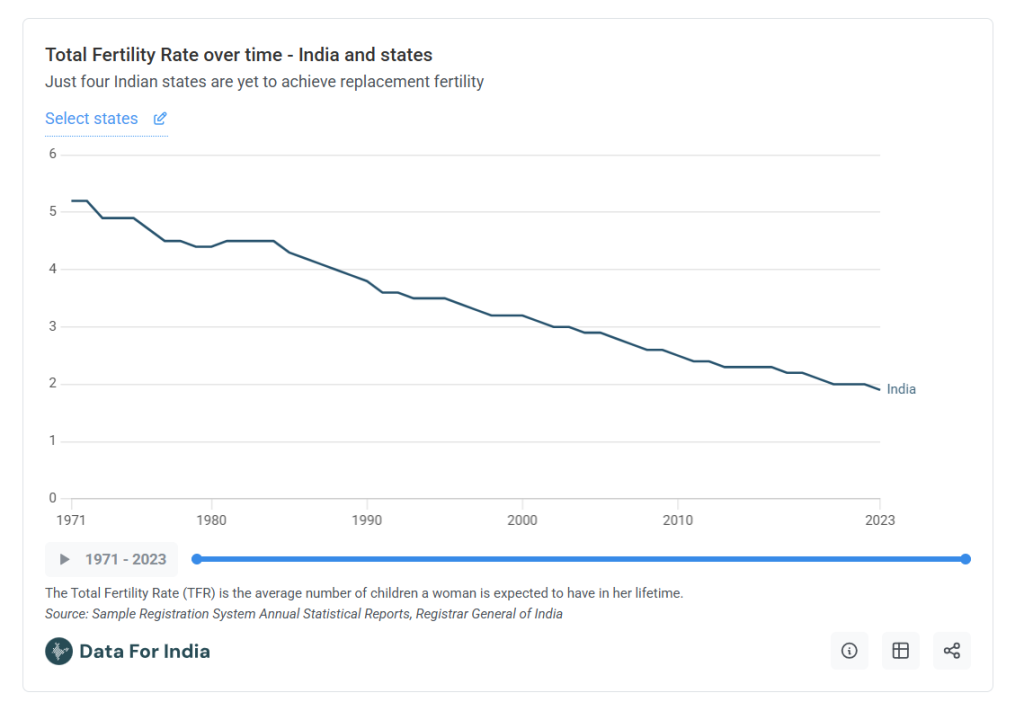
Over the past few decades, there has been a steady drop in the fertility rate. A woman in the country used to have about six children on average. Now, this number is below the replacement level TFR of 2.1. This is a big change in the nation’s population. In the next sections, we will talk more about these shifts in fertility rate and what they mean.
Key Decade-by-Decade Changes Since Independence
Since India became independent in 1947, the country has changed a lot in terms of its people and their numbers. Back in the 1950s and 60s, the birth rate in India was very high. There were often more than 40 births for every 1,000 people. At that time, child mortality was also high. A lot of children did not survive. Because of this, many families had more kids. They wanted to feel safe and secure by having bigger families.
The next decades saw slow but steady changes begin to take place. The government started running programs about family planning. Over time, better healthcare meant there were fewer deaths. Data from the Sample Registration System and the National Family Health Survey showed how the birth rate was dropping little by little. Since fewer children died at birth or soon after, people began to feel it was not needed to have large families anymore.
By the 21st century, there was a much faster drop in the fertility rate. The total population kept growing for some time because of how many people there were already. But it was easy to see that the main trend was changing. The NFHS-5 survey, carried out from 2019 to 2021, showed that India’s fertility rate had now gone below the replacement level. This was an important point in the history of the country’s people.
Shifts in Fertility and Birth Rates Over the Past Fifty Years
India’s fertility rate has seen a big drop in the last fifty years. Back then, the average number of children a woman would have was almost 5. Now, this number of children is at 2.0. That is below the replacement level, which is 2.1, meaning the population will not stay steady if we do not count movement of people in and out.
This drop is not only a number. It shows big changes happening in our society. The birth rate is the number of live births for every 1,000 people in a year. This has fallen a lot. It is close to the fertility rate, but they do not mean the same thing. The fertility rate gives a clearer idea of family size. A fall in both the birth rate and the death rate has changed the way India’s population looks now.
Here’s a quick look at how the fertility rate has changed over time:
| Time Period | Approximate TFR (Average Children Per Woman) |
|---|---|
| ca. 1970 | 5.0 – 5.5 |
| ca. 1992 | 3.4 |
| ca. 2021 | 2.0 |
This table shows a big decrease. It really changes how families work all over the country.
Main Drivers Behind Declining Birth Rates
What is behind lower birth rates? It’s not just one thing but many social and money matters working together. Fertility decline happened because many big changes took place over many years. Family planning programs run by the Government of India have helped too. A lot of the change has come from what people want and the choices they make by themselves.
People are making new reproductive choices for their families. This shift is happening because of changes in life and what people need. Things like living in cities, getting more education, and women having more say have each played a big part. Let’s take a closer look at these drivers and see how they affect reproductive choices.
Socioeconomic Factors and Urbanization
Socioeconomic factors play a big part in India’s changing population. The country is going through economic growth. Because of this, what families think is important is changing too. In the past, people in rural areas used to see children as extra help to get more work done. Now, families want to have fewer children. They try to give more to each child, so their kids can have a better way of life and good education.
Urbanization has played a big part in this. When people move from villages to cities for work and new chances, they find a new way of living. The cost of living is higher, there are housing limits, and people often focus more on their careers in cities. This makes families smaller than in rural areas. The number of live births for each woman in cities is always less than in rural areas.
Key reasons why cities grow and economies change are:
- The cost to bring up kids in cities is now higher.
- There are more women working in jobs now.
- More people now can get and use new birth control.
- There has been a change in culture, so people don’t feel a need to have big families like before.
Education, Women’s Empowerment, and Changing Family Norms
The drop in India’s birth rate is mostly because of better education, especially for women. Studies say that when women read and get more education, the average number of children they have goes down. Women who get an education wait longer to get married, choose to work, and help make choices about the number of children in the family.
This shows how women can feel stronger and have more say in their lives. When women get to make choices about their own bodies, they often have fewer children. They also wait longer between each child. This change helps lower the number of people. It gives good family health for the moms and the kids.
These trends are leading families in India to change how they live. People used to want to have big families. Now, most people want smaller families that are easier to care for. The shift comes from better education and more empowerment for all. This is making a big change in Indian society. It is one of the reasons why people in India are having fewer children these days.
Regional Differences in Birth Rates Across India
The national birth rate gives us some useful information. But it does not show all the big differences that are in regions. The way the population changes over time is not the same everywhere. If you look closely at the numbers, you will see a clear gap between different Indian states and union territories.
Some areas in the south and west have had low birth rates for many years. These are about the same as in many countries in Europe. On the other hand, some states in the north still have birth rates that are higher than the replacement level. These big differences matter a lot for planning and growth in the country. Now, we will look at which states have high and low birth rates.
High vs Low Birth Rate States and Union Territories
The fertility rates in India are not the same in every part of the country. Some states, including Uttar Pradesh, Bihar, and Madhya Pradesh in the north, have always had higher birth rates. These states still show TFRs above the replacement level. That is why they help a lot in India’s overall population growth.
States in the south like Tamil Nadu, Kerala, and Andhra Pradesh are at the other end. These places have much lower numbers of children born per woman, with TFRs far less than 2.0. Many union territories of India also show these low fertility rates. The gap between regions often comes because of differences in how well people read and write, how women feel about themselves and what they can do, and how good the economy is.
Here is a look at the fertility rate in some states. This helps you see how the numbers change in different places.
| State | Approximate TFR (2019-21) | Category |
|---|---|---|
| Uttar Pradesh | 2.4 | High |
| Madhya Pradesh | 2.0 | At Replacement |
| Andhra Pradesh | 1.7 | Low |
| Tamil Nadu | 1.6 | Low |
This table shows that there are many different groups of people living together in one country.
Urban vs Rural Comparisons
Beyond different states, the gap between urban areas and rural areas is another big part of how India’s birth rates are changing. People in urban areas have fewer children than those in rural areas. The total fertility rate in India’s cities is about 1.6, which is much lower than the replacement rate. In rural areas, the rate is 2.1, which is right at the replacement level.
This gap happens because of a few main reasons. People in urban areas often get better education and health care. They also have higher life expectancy than those in small towns or villages. In the city, people know more about modern ways to plan their families. The cost of living and jobs in city life also push people to have small families.
In rural areas, people often keep more traditional ideas about how many kids to have. There can be less good access to schools and doctors in these places. Still, the number of kids people have is going down in rural India too, but not as fast as in cities. This slow change in the countryside means a lot for how the country’s groups of people will look in the future. It also changes things like the sex ratio and how people live together.
Impacts of Declining Birth Rates on India’s Future
The drop in birth rates will change India’s future in a big way. When the number of children born goes below the replacement level, it does not mean that population growth will stop right away. But it does mean that India is entering a new time with different challenges. In the long run, the biggest effect will be that population growth will slow down little by little. After this, the number of people will even out, and then it could start to go down.
India will need to get ready for more older people living in the country. There are fewer children now, and people are living longer than before. A bigger part of the population will be old. This can bring some good things and some problems for the economy and social services. Let’s see how fewer children and an aging population could change the way people live and how the government might need to plan for it.
Effects on Population Growth and Demographic Patterns
Even if the replacement level TFR is at 2.0, there will still be more people in India over the next several years. This is called “population momentum.” It happens because the country has many young people right now. These young people were born during a time when families had more kids. Now, as they start to have their own families, even if each person has fewer children, there will be growth in the population because of the high number of people having kids.
Right now, India has a lot of young people, and this helps the economy. But over time, this will change. India will have more older people as the years go by. The country will move from being young to having a big aging population. The shape of the population, which looks like a pyramid today, will become more like a rectangle.
This change will need India to think about new goals for the country. The aim should move from making jobs for more working people, to giving good healthcare and help to older people. Handling this shift the right way will be one of the biggest things India will have to deal with over the next several years.
Challenges for Government Policy and Social Systems
The way the population is changing brings new problems for the Government of India. For many years, the focus was mainly on slowing down population growth. Now, the government has to think about what comes after a sharp fertility decline. The big issue now is taking care of an aging population and the needs they will have.
This will need big changes in the way our social systems work. A strong social security net is something we have to focus on. The old people will need good pensions and easy-to-get healthcare now more than ever. Rules that stopped people from having kids in the past may have to change. Family-friendly policies will get more attention, so the population stays steady for many years to come.
The government will need to look at many important points and work on them.
- The social security and healthcare systems need to get stronger. This is needed to help a growing number of older people.
- There should be a look at pro-family ideas such as better parental leave and more help for childcare.
- The Civil Registration System should be used to collect better data. This will help keep track of changes in the number of people and help us plan for the future.
Conclusion
To sum up, knowing about birth rates in India helps us see big trends that shape how the country grows in money and people. We can look at changes over the years and see that different areas are not all the same. These things show there is a link between school, city life, and the way families are changing. When birth rates drop, it is important to think about what this will mean for population growth, the age mix in the country, and the choices made by the government. Helping women and making school easy for everyone will be a big help with these new changes. By watching these trends and understanding what is going on, we can get a better idea of where India is headed with its people and what that will mean for all of us. If you want to know more or you have any questions, feel free to reach out!
Frequently Asked Questions
What is India’s birth-rate? Is it a cause for concern?
India’s birth rate is about 16.4 births for every 1,000 people. A key number here is the fertility rate, which stands at 2.0. This is a little less than the replacement level of 2.1. Many experts and United Nations reports say that this is not a problem right now. In fact, they see it as a good sign. Over time, this will help balance India’s population.
How many children are born in one minute in India?
Recent numbers from the Sample Registration System show that there are about 25 million live births each year in India. This means close to 48 children are born every minute. The number helps us see how big the population is, even as India faces declining fertility rates.
How many people are born in India in a day?
India has around 25 million live births every year. That means about 68,000 to 70,000 babies are born in India each day. This big birth rate is still adding to population growth in the country. The increase keeps happening even though the rate of growth is slowing down now. These facts come from the National Family Health survey, which looks at family health and population growth in India.




